
Zimbabwe round-up: Glen View fire, constitutional wrangling, Warriors’ Congo test and a Vurombo school-bus milestone
For readers in Harare and across Zimbabwe, the latest headlines are a reminder that national progress and urban risk often move side by side. A costly industrial fire in Glen View, continuing argument over constitutional change, tension around street vendors, and a road attack near Kwekwe speak to gaps in safety, planning and enforcement. At the same time, the national football team’s continental qualifying effort, a cultural festival celebrating the mbira, a school-bus achievement in Masvingo, a tech award in Abuja and literary recognition in New York point to capability, creativity and public spirit that many Zimbabweans still want to see reflected in everyday service delivery.
Harare industry: Glen View fire reopens safety and planning debate
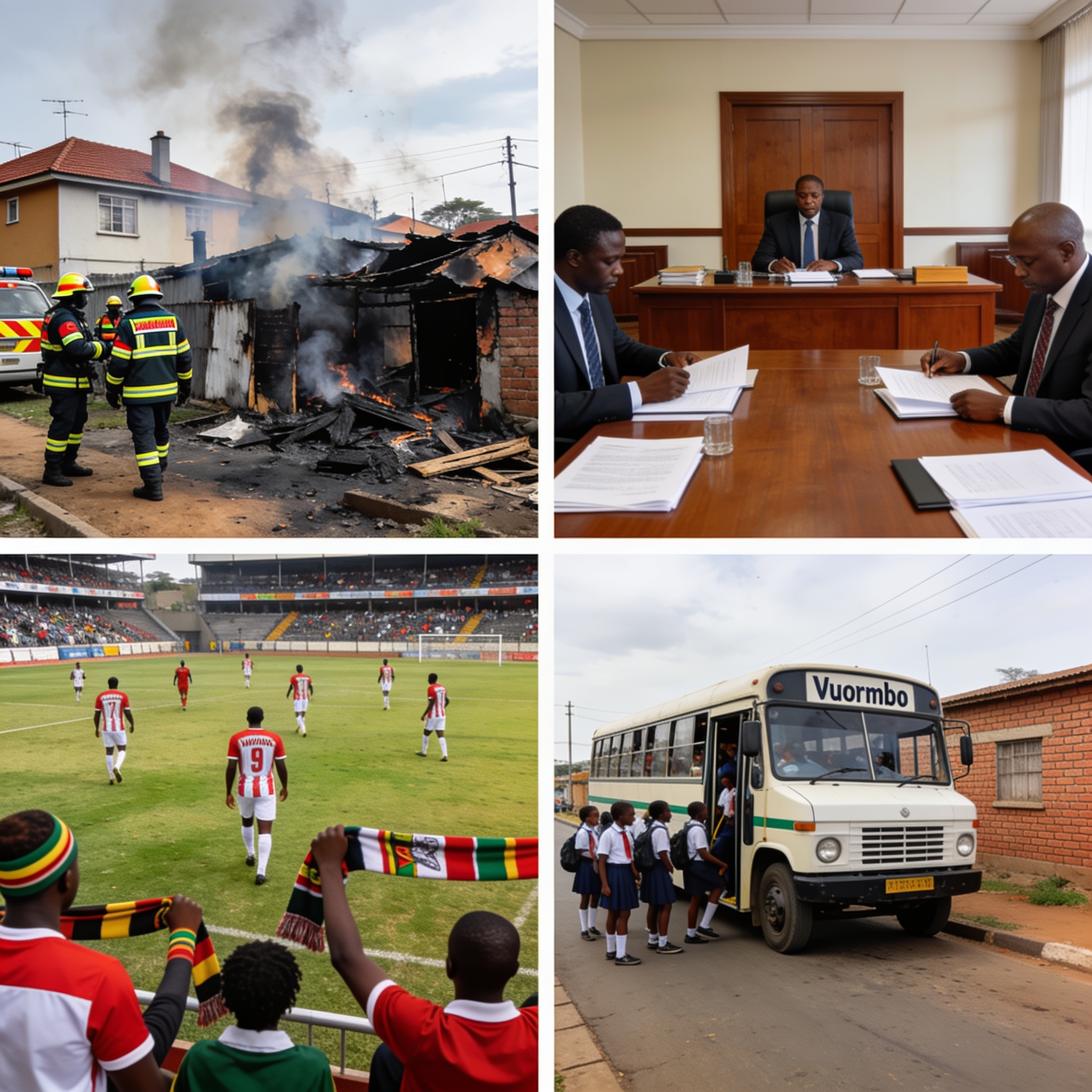
Reports of another damaging blaze in the Glen View Home Industry area have put renewed attention on fire prevention, land-use planning and the vulnerability of small manufacturing clusters. The incident matters to Harare because it involves a dense zone where livelihoods are packed into makeshift or semi-fitted premises. When furniture makers, artisans and traders lose stock, tools and workshop space to fire, the shock is not only personal; it weakens a local supply network that depends on steady orders, transport and market confidence.
The wider question is whether the city can move from emergency response to prevention. Better access for fire appliances, safer electrical installation, designated storage, enforcement against hazardous modifications and a credible relocation or upgrade programme for compliant manufacturers are all part of the answer. Harare residents are likely to judge officials by the consistency of that response, especially when industrial accidents recur.
Politics: constitutional dispute and vendor governance test authority
The political story still gripping Zimbabwean public debate centres on the constitutional amendment process. Published accounts say the government has begun circulating printed versions of the constitution that incorporate the disputed changes while legal challenges remain pending and court schedules have been affected. That creates an unusual atmosphere: administrative action moves ahead, courts are asked to adjudicate, and citizens are left to assess whether law, process and legitimacy are being aligned or stretched.
For Harare, where civic life is more visible and professional voices more numerous, such developments invite scrutiny. Urban readers care about the consequences of constitutional uncertainty: municipal governance, business contracts, land tenure, rights of assembly, and confidence in institutions. A legal process that appears to be paused, postponed or overtaken by publication will raise more questions than answers.
The same scrutiny applies to street vendors. Reports describe a ruling party and local government weighing how to manage informal trading amid economic pressure and public discontent. Harare’s sidewalks and inner-city corridors are among the country’s most contested public spaces. The challenge is not to romanticize informality, but to recognize that vendor livelihoods intersect with pedestrian safety, municipal revenue, policing and trust. If regulation becomes coercive without alternatives, resistance follows. If it becomes formalized without fairness, frustration remains.
Also in the civic-political mix, a human-rights clarification says Parliament and the Zimbabwe Human Rights Commission should still oversee municipal police even as local authorities receive more enforcement powers. Harare’s residents are likely to welcome the principle: new powers need limits. Municipal policing can protect marketplaces and public order, but it can also become an instrument of harassment if accountability is weak.
Security: road corridors remain exposed
A reported taxi-driver attack and vehicle theft along a route connecting Kwekwe and Chiundura reinforces a familiar concern: road transport users are still exposed where surveillance, lighting and rapid response are thin. For commuters and operators, the cost is immediate—vehicle, equipment and safety. For the broader economy, the effect is higher insurance, lower confidence in movement and pressure on already fragile public transport.
Harare’s own ring-road and satellite corridors need similar attention. Urban and peri-urban transport cannot depend on informal vigilance alone. Better radio coordination, speed checks, visible patrols, route-based incident reporting and reliable police response are practical steps that residents can demand and institutions can measure.
Culture and education: Mbira festival, school bus and university purpose
Not all Zimbabwe news is alarmist. The Bira reMbira Festival at Harare Showgrounds brought together traditional practitioners, younger performers, students and visitors around an instrument that carries memory, ceremony and national identity. For a city often divided by class, language and consumption, the mbira offers something shared. Its value is not only musical; it is civic. Public culture creates spaces where Harare residents see themselves beyond traffic, prices and political argument.
The educational milestone from Masvingo is also worth noticing because it speaks to school-community capacity. Vurombo Primary, after decades without its own bus, has acquired a 76-seat coach supported by the school-development committee, parents and administration. The result is practical: sports travel, trips and programme logistics become easier for a school with more than 1 400 pupils. But the symbolic result matters as well: parents and committees can solve public-service gaps when they pool trust and resources.
Harare’s universities and technical institutions are also being urged to do more than produce certificates. The message is familiar but urgent: graduates should carry problem-solving skills back into communities. In a city facing infrastructure, waste, transport and safety pressures, that call could become a practical test of whether higher education is shaping service leaders rather than credential holders.
Sports: Warriors, Cheetahs and a stadium test in Harare
Sport offers another barometer of national mood. The Warriors’ captain and coach are rallying supporters ahead of a crucial match against the Democratic Republic of Congo, with Harare’s National Sports Stadium expected to play a part in morale and tactical pressure. For Zimbabwe, qualifying football remains one of the few arenas where a single crowd can make the whole country feel collectively represented. The warning from previous encounters is simple: home advantage must not turn into expectation without preparation.
Abroad, Zimbabwe’s Cheetahs opened the Rugby Africa Men’s Sevens Series in Kampala with unbeaten momentum, defeating Morocco and Ghana. Such results matter beyond the scoreboard. They create pathways for athlete development, sponsorship interest and public pride. They also show that Zimbabwean sport can compete when planning, fitness and team discipline are taken seriously.
The women’s cricket side faces a different pressure: a must-win second ODI against the West Indies at Harare Sports Club after losing the opener. In cricket, margins are clinical; a series can be lost before the final match if the second game slips. Harare’s cricket community will want composure, fielding sharpness and a better opening response.
Recognition abroad: technology, literature and heritage
Zimbabwean expertise is also being recognised outside the country. Technology professional Fungai Jacqueline Kiwa is set to receive an award in Abuja as one of Africa’s emerging CEOs in artificial intelligence and digital transformation. For Harare, that recognition has practical relevance: AI, digital payments, data governance and platform regulation are no longer distant conference topics. They are shaping how city government, commerce and service delivery function.
A Zimbabwean teenage writer on a New York shortlist and other literary momentum suggest that storytelling continues to carry Zimbabwe’s reputation internationally. This is not decorative news. It affects tourism, publishing, education and soft power. If young writers can gain global platforms, then investment in libraries, school reading, creative hubs and digital distribution should also become a civic priority.
Vice President Kembo Mohadi’s presence at the inaugural Tshitaudze Heritage Festival in Beitbridge, meanwhile, signals state attention to cultural heritage outside Harare. For a capital-centric news flow, that is important: Zimbabwe’s identity is built across provincial, ethnic and historical sites as well as in boardrooms and stadiums.
Media and governance notes: ZMC resignation and court-related farm access
Two smaller but telling developments deserve mention. Former Zimbabwe Media Commission acting executive secretary Brain Mangoro has reportedly resigned and moved to the National Prosecuting Authority. In a sector still wrestling with licensing, digital platforms, public broadcasters and press freedom, senior personnel changes at media institutions are rarely administrative trivia. They can signal strategic direction, regulatory posture and confidence in media governance.
Former minister Dzikamai Mavhaire has also responded to controversy around boom gates at Hillview Farm in Masvingo, saying a High Court matter concerned road access rather than mining control. Disputes around private access, local roads and resource claims are common in rural-urban friction zones. Harare readers should care because access decisions shape supply chains, community mobility and the credibility of land-related governance.
What Harare readers should carry from the day
The common thread is accountability in three areas: safety, legality and public participation. Glen View’s fire demands preventive infrastructure. Constitutional uncertainty demands transparent legal process. Vendor regulation demands dignity and alternatives. Road attacks demand visible security. School buses demand community-led delivery. Stadium and cricket performances demand preparation. Tech and literary awards demand pathways from global recognition to local opportunity.
For news-harare.com readers, the takeaway is not to choose between alarm and pride. Zimbabwe often delivers both on the same day. The capital’s role is to connect the dots: how a Harare fire, a Masvingo school bus, a Kampala sevens match, an Abuja award and a New York shortlist can all point to the same question—whether talent, culture and civic energy are being translated into safer streets, fairer rules and better services.