

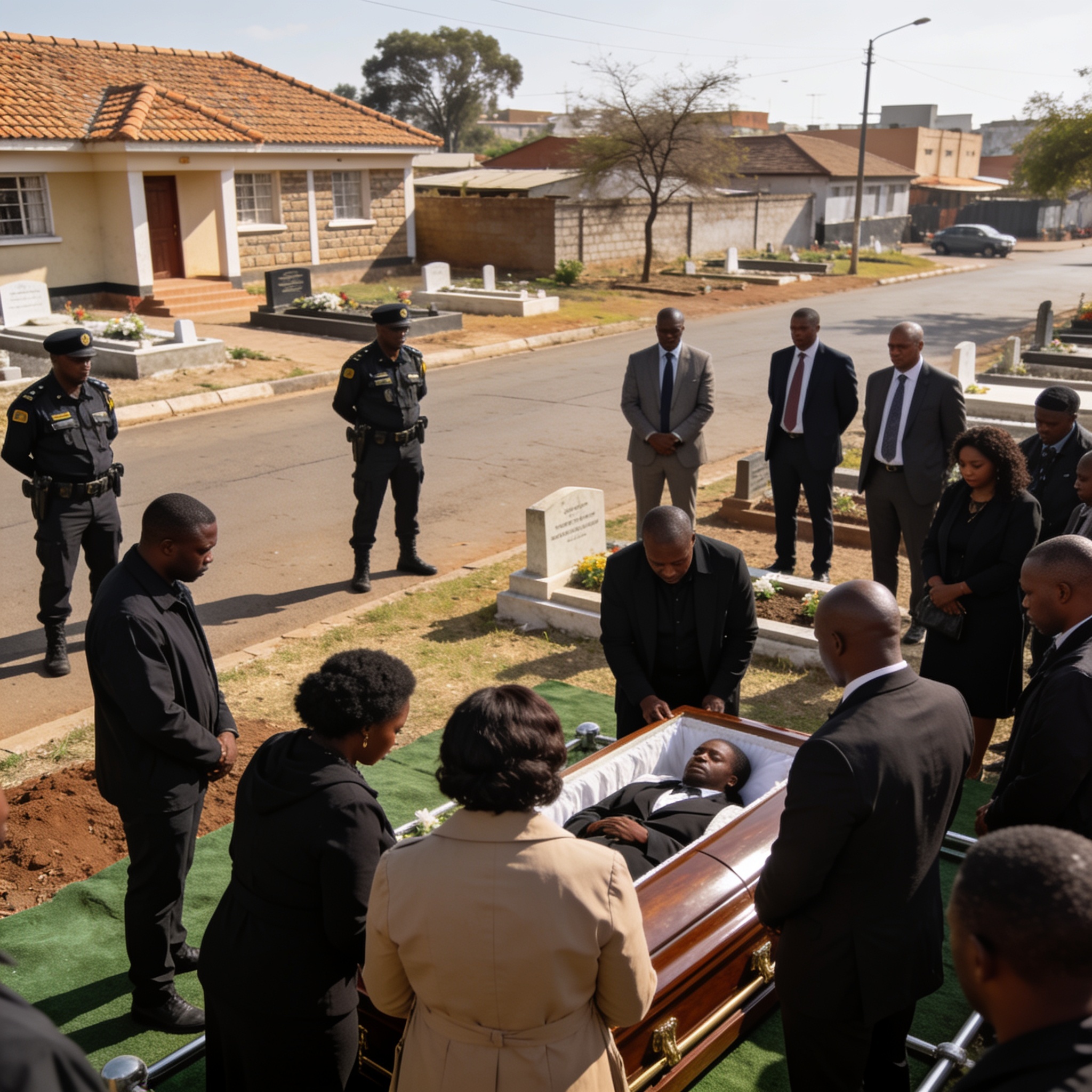
HARARE — Zimbabwe’s capital is moving toward a funeral that has stopped being a private bereavement and become a national test of how wealth, influence and public accountability intersect in 2026. Businessman Wicknell Chivayo and his wife, Lucy Muteke, are expected to be laid to rest at Glen Forest Cemetery in a service set for 2pm on Thursday, their families have announced.
The couple died last week when a helicopter carrying them crashed in rural Marondera, along with two aviation crew members and a security aide. The tragedy has drawn mourners, media attention and a broader conversation about emergency preparedness, political succession, religious speculation and the limits of celebrity philanthropy in a still fragile economy.
A Harare funeral that reflects wider anxiety
For many residents, the burial is not only about one prominent figure. It is a moment when Harare’s street-level frustrations meet elite networks. In recent days, the city has been shaped by reports of residents paying twice for unreliable municipal services, traders resisting enforcement against informal trade, and older persons pressing for dignified pensions. Those concerns, though separate from the crash, sit in the same social landscape: a public that wants functioning institutions, fair treatment and answers that go beyond eulogies.
The death of a high-profile businessman whose donations to sports and social causes made him familiar to ordinary Zimbabweans has created an emotional pull across class lines. Yet the funeral’s visibility may also sharpen scepticism among Harareites who see a pattern: generous public gestures on one hand, opaque private finance and political proximity on the other.
Why the Marondera crash is being read as a systems failure
One of the most important threads running through public commentary is safety. The helicopter accident near Marondera is already prompting questions about whether Zimbabwe’s emergency framework can respond quickly when incidents occur outside major cities, especially on remote farms and rural roads.
Reports from the scene have exposed a divide: prominent victims can command immediate attention, aircraft resources and coordinated medical movement, while ordinary citizens in isolated areas often wait longer for ambulances, rescue tools and basic communication infrastructure. If that gap is treated as a normal reality, the tragedy risks becoming another example of how privilege shapes access to survival.
Government officials and safety bodies have a duty to explain not only how the aircraft went down, but how rescue and medical evacuation were organised, what systems failed, and what changes will make the next accident less lethal for a farmer, a school teacher or a minibus commuter.
Hero status raises hard questions
President Emmerson Mnangagwa has granted Chivayo a provincial hero distinction, citing his public contributions and charitable work. Such recognition is not unusual for figures who support sports, schools or religious causes, but in Zimbabwe’s political environment it cannot remain a purely ceremonial act.
Readers will remember that Chivayo’s philanthropy was closely linked to political messaging and to controversial donations that touched state-aligned institutions. Hero status should not prevent an independent accounting of how private wealth entered public spaces, whether any funds or donations were connected to procurement or political favour, and whether his business interests operated under transparent rules.
A funeral can honour lives. Public policy must still protect fairness.
Succession calculations after a death
The Chivayo tragedy also lands in the middle of Zimbabwe’s succession argument, where elite alliances are tested and rival networks search for new openings. Some political commentators argue that the businessman’s influence had become part of a broader ecosystem tied to powerful commercial figures and loyalist structures. His death, they suggest, may alter balance rather than simply replace a personality.
Recent remarks by public commentator Tungwarara have described a commercial and political group in which Chivayo occupied a senior but subordinate position, below another prominent business figure. Those comments remain assertions rather than established facts, yet they show how quickly Zimbabwe’s public debate moves from mourning to power mapping.
For Harare, that matters because succession talk is not abstract. It influences appointments, donor flows, state procurement, security priorities and the tone of civic expression.
Prophets, explanations and the search for control
Religious commentary has added another layer. Prophet Walter Makandiwa’s response defending spiritual figures over failures to predict the accident illustrates how many Zimbabweans turn to faith when sudden loss overwhelms rational explanation. In a society marked by economic stress and political uncertainty, prophecy can feel like a language of control.
News-Harare should be careful here. The search for spiritual explanation is understandable, but it must not distract from the practical demand: stronger aviation oversight, clearer rescue protocols and better hospital capacity across Marondera, Harare and the rest of the country.
A cross-border allegation that should be treated cautiously
The story has also attracted regional noise. Former Kenyan deputy president Rigathi Gachagua has made sweeping claims that Chivayo was holding billions of dollars connected to President William Ruto and Kenyan election technology plans. These are allegations from a political figure with his own agenda, and no evidence was offered to support the figures cited.
Zimbabwean readers should avoid amplifying them as fact. They do, however, underline how Chivayo’s death has entered a transnational rumour economy, where unverified financial narratives spread quickly across social media.
What News-Harare readers should watch next
- Whether authorities publish a clear, independent accident report on the Marondera crash.
- Whether government moves to improve emergency response beyond high-profile cases.
- Whether public scrutiny continues into donations, business links and political protection.
- Whether succession politics in the ruling party and allied networks reshape around the death.
- Whether Harare residents receive concrete relief on service costs, pensions and urban livelihoods.
The burial will be emotional. It should not be final. Zimbabwe’s capital needs a funeral lesson that leads to safer skies, fairer public finance, stronger institutions and less dependence on powerful individuals.