
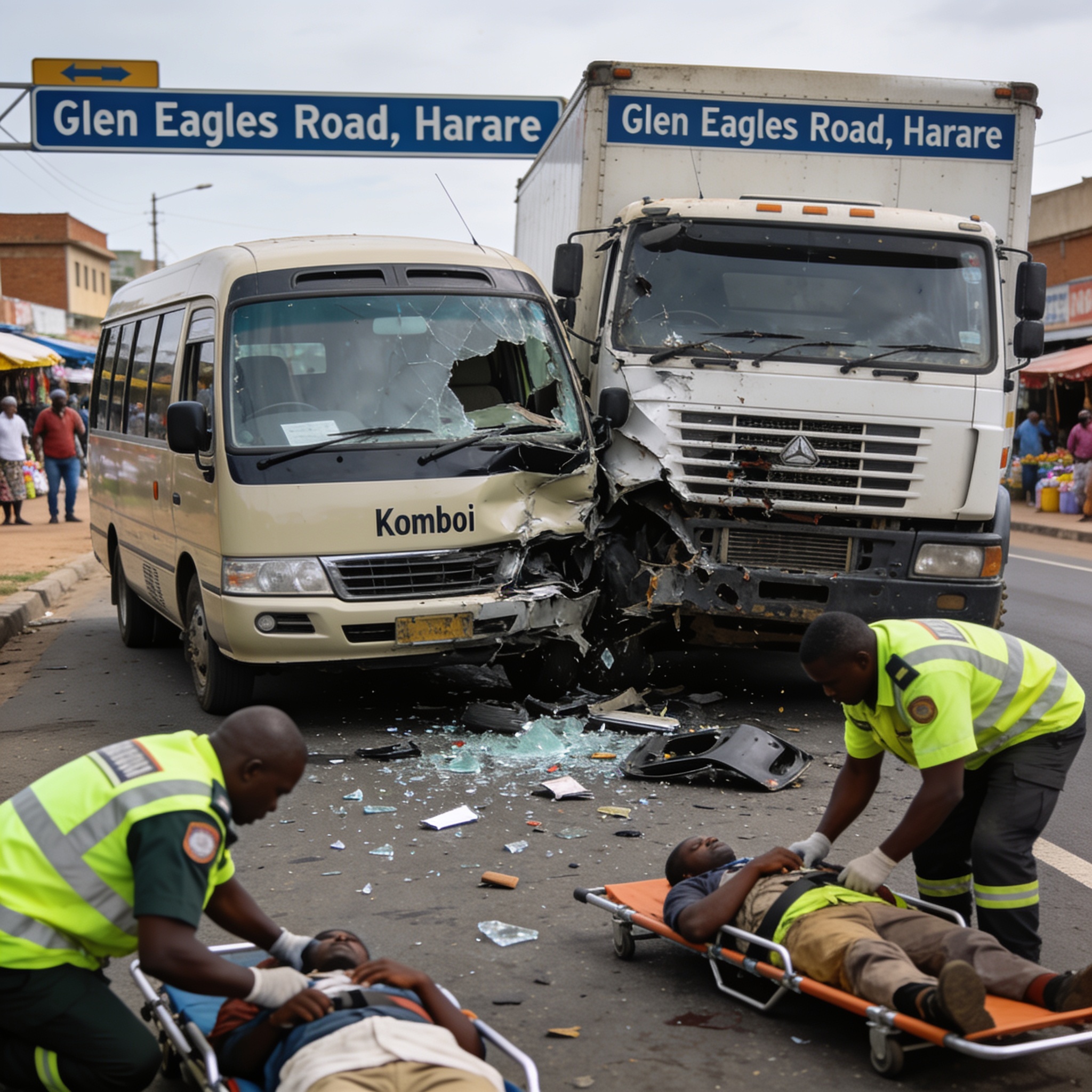
Three people lost their lives and 19 others were rushed to hospital on Wednesday evening after a commuter omnibus and a heavy truck collided head-on along Glen Eagles Road in Harare, the Zimbabwe Republic Police have confirmed.
According to the police statement, the crash occurred at approximately 5.30pm on 23 September 2026, near First Class Bus Garage. A Toyota Hiace kombi was travelling with 20 passengers on board, while the Mercedes-Benz truck involved in the collision had three occupants.
Police said the bodies of the deceased were transported to the Sally Mugabe Hospital mortuary for post-mortem examinations, while the injured were admitted at the same institution for treatment. The condition of the survivors was not immediately disclosed.
Authorities have not yet indicated what caused the vehicles to collide, and investigations into the circumstances of the accident are understood to be ongoing.
A busy route, a familiar tragedy
Glen Eagles Road serves as a key link between several northern Harare suburbs and the central business district, carrying a steady stream of commuters, delivery vehicles and heavy trucks throughout the day. The stretch near the bus garage is well known to residents who use it daily.
Wednesday’s collision is the kind of incident that has become tragically routine on Zimbabwe’s roads, where commuter omnibuses — the backbone of urban public transport — share narrow, often poorly maintained carriageways with haulage trucks and private cars.
Pressure on the kombi system
Commuter omnibuses move the overwhelming majority of Harare’s workforce every day, but the sector has long operated under strain. Operators face rising fuel costs, ageing vehicles and intense competition for passengers, all of which can encourage speeding and overloading.
Passengers on the city’s busiest routes frequently describe journeys where vehicles are packed beyond their designed capacity. The kombi in Wednesday’s crash was carrying 20 passengers at the time of the collision.
Road safety advocates have repeatedly argued that meaningful progress requires a combination of enforcement, vehicle fitness testing and better alternative transport options for commuters who currently have little choice but to board whatever vehicle arrives first.
Hospital capacity under scrutiny
The admission of 19 injured people in a single incident places immediate pressure on Sally Mugabe Hospital, one of Harare’s largest referral facilities. The hospital has in the past described being stretched by the volume of trauma cases arriving from road accidents.
Families seeking information about relatives involved in the crash are advised to contact the hospital or the nearest police station.
What police are saying
The ZRP confirmed the fatal collision and said the victims’ bodies had been taken for post-mortem while survivors were receiving care. The police did not release the names of the deceased, and no further details on the sequence of events were provided at the time of writing.
Officers are appealing to motorists to exercise caution on the roads, particularly during evening peak hours when traffic volumes are high and visibility can deteriorate.
A broader road safety question
Each serious crash in and around Harare reignites debate about how the city manages the competing demands of public transport, freight movement and private vehicles on a road network that has not kept pace with population growth.
For now, the immediate focus remains on the three families who lost relatives on Wednesday and the 19 people recovering in hospital. But the collision also raises familiar questions that authorities have yet to answer: how many more head-on crashes will it take before enforcement and investment in transport infrastructure match the scale of the problem?
Anyone with information about the accident is encouraged to report it to their nearest police station.